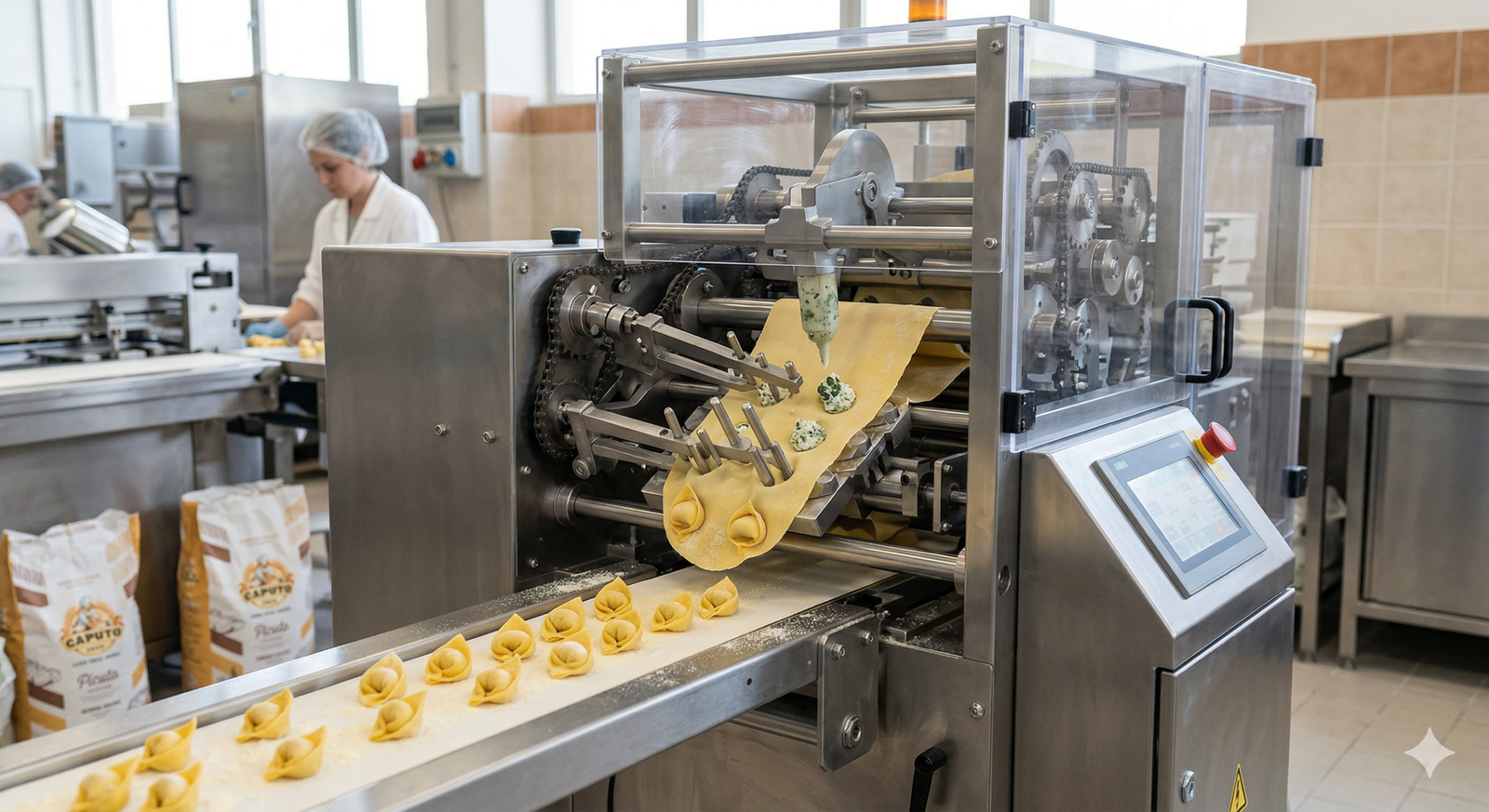
The Future of Pasta Engineering How the Tortellinatrice is Revolutionizing Food Tech
In the rapidly evolving world of food technology, the demand for precision, speed, and consistency has never been higher. For centuries, the art of making tortellini was a labor-intensive craft passed down through generations in Italian kitchens. However, as global appetite for authentic filled pasta grows, the industry has turned to a marvel of mechanical engineering: the Tortellinatrice. This sophisticated machine represents the perfect marriage between traditional culinary arts and modern industrial automation, ensuring that every piece of pasta maintains the “handmade” quality while meeting massive commercial demands.
The Tortellinatrice is not just a simple pasta cutter; it is a high-tech solution designed to handle delicate dough and varied fillings with surgical precision. For pasta manufacturers and food tech enthusiasts, understanding this machinery is key to grasping how the food supply chain maintains quality at scale. In this comprehensive guide, we will explore the technical nuances, operational benefits, and the latest innovations surrounding tortellini production. Whether you are a factory owner looking to optimize your line or a tech-curious foodie, this article offers a deep dive into the engineering that puts world-class pasta on your plate.
What Exactly is a Tortellinatrice?
The term Tortellinatrice refers to a specialized industrial machine dedicated to the automated forming of tortellini, cappelletti, and other folded stuffed pastas. Unlike standard ravioli machines that simply crimp two sheets of dough together, this machine must perform a complex “pinch and twist” motion to replicate the traditional navel shape of a tortellini.
- Mechanical Complexity: It uses a series of synchronized cams and pistons to fold the dough around a calibrated “finger.”
- Versatility: Most modern units are “multi-format,” meaning they can switch between different sizes and shapes with a simple die change.
- Hygiene Standards: Built almost entirely from stainless steel (AISI 304 or 316), they meet the strictest global food safety regulations.
The Role of Automation in Pasta Tech
Automation in the food sector is no longer a luxury—it is a necessity for survival. The Tortellinatrice serves as a pillar of this shift, replacing hundreds of manual labor hours with a single, high-output system. This transition allows for a level of consistency that human hands simply cannot sustain over an eight-hour shift.
- Standardization: Every single tortellino has the exact same dough-to-filling ratio.
- Waste Reduction: Advanced sensors ensure that filling is only dispensed when a dough sheet is present.
- Speed: Modern machines can produce up to 150 kilograms of finished product per hour.
Key Technical Components of the Machine
To understand a Tortellinatrice, one must look at the “engine room” of the device. It is a symphony of mechanical timing where the dough sheet and filling must meet at the exact millisecond. If the timing is off by even a fraction, the pasta will tear or leak.
- Laminating Rollers: These thin the dough to a precise micron-level thickness.
- Injection Pumps: These handle the filling, whether it’s smooth cheese or chunky meat.
- Folding Pins: The mechanical “fingers” that give the tortellini its iconic shape.
Engineering the Perfect Dough Sheet
The success of a Tortellinatrice depends heavily on the quality of the dough fed into it. In the tech niche, we refer to this as “input quality.” If the dough lacks the correct elasticity or moisture content, the machine’s mechanical parts will struggle to form the fold.
- Moisture Control: Typically, dough for these machines requires a moisture level of 28% to 32%.
- Gluten Development: The mixing phase must ensure enough strength to survive the mechanical folding.
- Sheet Width: Machines are usually rated by their sheet width, often 160mm, 250mm, or 540mm.
Comparison: Manual vs. Automated Production
When comparing traditional methods to the Tortellinatrice, the data highlights a staggering difference in efficiency. While a skilled artisan might produce a few kilograms an hour, the machine scales this by a factor of fifty.
| Feature | Manual Production | Tortellinatrice (Industrial) |
| Output Speed | 1–2 kg per hour | 50–150 kg per hour |
| Consistency | Variable (Human Error) | 99.9% Uniformity |
| Labor Cost | High (Skilled Artisans) | Low (Single Operator) |
| Shape Precision | Artistic/Unique | Geometrically Perfect |
Filling Systems and Volumetric Accuracy
One of the greatest challenges in food tech is managing “viscosity.” The Tortellinatrice must be able to pump a wide variety of fillings—from ricotta and spinach to braised beef—without clogging or crushing the ingredients.
- Piston Dosing: Uses a vacuum-pressure system for high accuracy.
- Interchangeable Tubes: Allows the machine to handle different textures without damaging the pump.
- Continuous Feed: Ensures there are no air pockets inside the pasta.
The Importance of Interchangeable Dies
In the modern market, consumer preferences change quickly. A brand might need to produce small “Tortellini” one day and larger “Tortelloni” the next. The Tortellinatrice accommodates this through modular engineering.
- Quick-Change System: Modern machines allow die sets to be swapped in under 30 minutes.
- Format Variety: Supports different shapes like “mignon,” “standard,” or “giant.”
- Cost Efficiency: Instead of buying a new machine, owners simply buy a new set of molds.
Integration with Industry 4.0
The latest generation of the Tortellinatrice is fully “smart.” These machines are equipped with PLC (Programmable Logic Controller) systems and touchscreen interfaces that allow for remote monitoring and data collection.
- IoT Connectivity: Factory managers can track production metrics from a smartphone.
- Predictive Maintenance: The machine alerts the tech team before a part fails.
- Recipe Storage: All parameters (speed, thickness, filling) are saved digitally for instant recall.
Cleaning and Sanitation Protocols
In the information niche of food tech, “cleanability” is a primary design metric. A Tortellinatrice must be disassembled and sanitized daily to prevent bacterial growth, a process that used to take hours but is now streamlined.
- Wash-Down Design: Electronics are sealed (IP65 or higher) to allow for pressurized water cleaning.
- Tool-less Disassembly: Many parts can be removed by hand for deep cleaning.
- Antimicrobial Materials: Use of specialized plastics and high-grade steel.
Evolution of Pasta Shaping Technology
The history of the Tortellinatrice is a journey from simple wooden molds to high-speed robotics. Early machines in the mid-20th century were loud and prone to jamming, but today’s models are whisper-quiet and incredibly reliable.
- 1950s: The first mechanical “shapers” appear in Italy.
- 1980s: Electronic timing improves speed and reduces dough tearing.
- 2020s: AI and vision systems begin to check for defects in real-time.
Economic Impact on Food Businesses
Investing in a Tortellinatrice is a major capital expenditure, but the Return on Investment (ROI) is often seen within 12 to 18 months for mid-sized pasta factories.
- Increased Margin: Lower labor costs mean higher profit per kilogram.
- Market Expansion: Ability to supply supermarkets and export markets.
- Brand Trust: Uniform product builds consumer loyalty and brand recognition.
Handling Difficult Ingredients
Tech-forward machines now feature “gentle handling” technology. This allows the Tortellinatrice to process delicate ingredients like whole pieces of mushroom or high-moisture cheeses that would have been impossible to machine-fold a decade ago.
- Variable Speed Drives: Slows down the folding process for fragile dough.
- Anti-Stick Coatings: Specialized surfaces prevent dough from sticking to the rollers.
- Pressure Sensors: Automatically adjust the filling pump if a blockage is detected.
Energy Efficiency in Modern Models
With the rise of green tech, modern Tortellinatrice designs focus on reducing the carbon footprint of pasta production. This is achieved through high-efficiency motors and smarter power management.
- Servo Motors: Only use energy when a movement is actually occurring.
- Heat Reduction: Friction-reducing designs keep the dough cool, preserving flavor.
- Recyclable Parts: Focus on long-lasting components that can be refurbished.
Global Market Leaders and Manufacturers
Several Italian companies dominate the market for the Tortellinatrice, providing the gold standard for these machines worldwide. Brands like Italpast, Pavan, and Dominioni are the “Ferraris” of the pasta machinery world.
- Customization: These manufacturers often build machines tailored to specific regional pasta styles.
- Support: They provide global technician networks for setup and training.
- Innovation: These companies lead the R&D in new folding techniques.
Case Study: Small Batch to Industrial Scale
Consider a family-owned pasta shop that moved from hand-making to a small-scale Tortellinatrice.
The Results:
- Production Increase: From 10kg/day to 100kg/day.
- Staffing: Reallocated 3 staff members from shaping to creative recipe development.
- Quality: Consumer blind tests showed no detectable difference in taste between manual and machine versions.
Frequently Asked Questions
What is the average price of a professional Tortellinatrice?
The price varies significantly based on output capacity. Entry-level artisanal machines can start around $15,000, while high-speed industrial lines for large factories can exceed $100,000. It is an investment in long-term scalability.
Can a Tortellinatrice make gluten-free pasta?
Yes, modern machines are designed with specific rollers and timing to handle the fragile nature of gluten-free dough. However, a specialized “Gluten-Free” die set and a different moisture calibration are usually required for the best results.
Is it hard to clean an industrial tortellini machine?
Not anymore. Leading manufacturers design these machines for “easy-strip” cleaning. Most parts that touch food can be removed without tools, and the stainless steel frame is designed to be sprayed down with food-safe sanitizers.
How many people are needed to operate the machine?
A single trained operator is typically enough to run a Tortellinatrice. Their role is to monitor the dough sheet feed, refill the filling hopper, and ensure the finished product is moving correctly to the pasteurizer or dryer.
Can I change the shape of the pasta easily?
Absolutely. Most machines are “interchangeable,” meaning you can swap the internal molds to produce different shapes. This process usually takes between 20 to 45 minutes, depending on the model’s complexity.
Does the machine affect the taste of the pasta?
The machine itself does not affect the flavor, but it does affect the texture. High-quality rollers mimic the “rough” texture of a rolling pin, which helps sauce stick to the pasta better than cheaper, smoother alternatives.
How long does a Tortellinatrice last?
With proper maintenance and daily cleaning, an industrial Tortellinatrice can easily last 20 to 30 years. Many factories use refurbished models from the 1990s that still perform exceptionally well today.
Conclusion: Embracing the Future of Pasta Production
The Tortellinatrice stands as a testament to how technology can honor tradition rather than replace it. By automating the most difficult and repetitive parts of pasta making, this machine allows producers to focus on what truly matters: the quality of the ingredients and the creativity of the flavors. We have seen how these machines provide unmatched consistency, drastically reduce labor costs, and open doors for businesses to scale from local shops to international brands.
As we look toward the future of food technology, the integration of AI, IoT, and even more precise mechanical engineering will continue to refine the way we produce filled pasta. For any business in the food industry, understanding the power of a Tortellinatrice is the first step toward modernization. It ensures that the beloved tortellini remains accessible, affordable, and delicious for everyone, everywhere. If you are ready to take your production to the next level, exploring the latest models and technical specifications of these machines is a journey well worth taking. The bridge between the past and the future is built with stainless steel and synchronized gears, and it has never tasted better.